
No, your child does not need to sit piano exams to become a good pianist. Graded exams suit some children, but many learn more, and enjoy it more, when lessons are about playing, creating and composing rather than preparing set pieces for an examiner. That is why our piano lessons in Desa Sri Hartamas are taught without exams, by design.
Exams are not a bad thing, and plenty of fine musicians have sat them. They are simply one way to learn, not the only way. Here is what they offer, what they cost a young learner, and how progress works when there is no certificate at the end of the term.
What a piano exam actually tests
Most piano exams that families in Malaysia hear about follow a graded system, from Grade 1 up to Grade 8. The ABRSM practical grades, for example, assess four things:
- Set pieces: usually three, chosen from a published list for that grade.
- Scales and arpeggios: played from memory when the examiner asks for them.
- Sight-reading: playing a short piece the student has not seen before.
- Aural tests: listening tasks covering pitch, rhythm and other musical features.
These are all useful skills. The question for parents is not whether the skills matter (they do) but whether a child needs an exam to build them.
Why some families choose exams
To be fair to exams, they do some things well:
- A clear target. A date on the calendar gives some children a reason to practise.
- Outside feedback. An examiner who has never met the student gives an independent view.
- A certificate. Some parents like a record of progress that others recognise.
For a child who loves goals and handles pressure well, an exam can be motivating. If that describes your child, and a certificate is a firm goal, an exam-focused teacher may be the right fit, and that is a perfectly sensible choice.
The hidden cost of learning for the exam
The trouble starts when the exam becomes the whole course. Many families will recognise the pattern:
- The same three pieces for months. A child can spend most of a year polishing a handful of set pieces, with little time for anything else.
- Practice that feels like homework. When every session is about passing, the piano can start to feel like another school subject.
- Nerves that stick. For an anxious child, being judged in a quiet room by a stranger can make music feel like something to fear.
- Little room to create. Improvising, writing a tune or playing a song they love rarely fits into an exam syllabus.
When children give up an instrument, it is often not for lack of talent but because playing stopped being enjoyable. Keeping music something a child wants to do is often worth more than any grade.
How our piano lessons work without exams
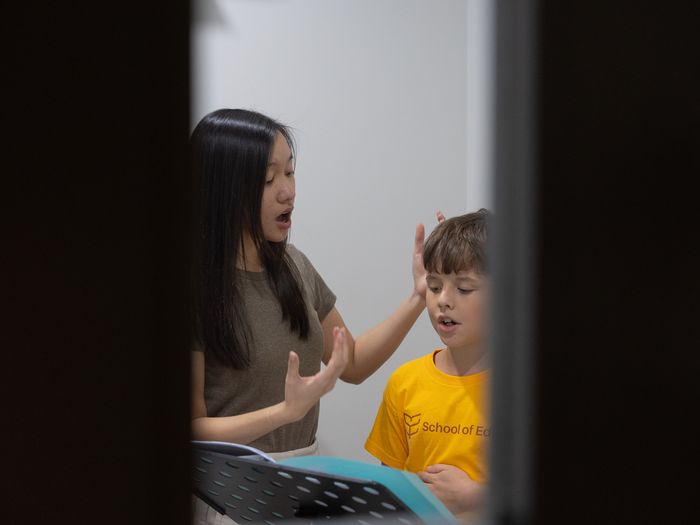
At Master Artist, piano and instrument lessons are paced to wherever a student is starting from, with no exams: just real playing, creating and composing. We teach music to be loved, not feared. Lessons are 60 minutes, once a week, in a private soundproof room, and are open to ages 5 through to adult.
Instead of grades, students move through three stages:
- Beginner. Note-reading, hand position and simple pieces: a first, unintimidating introduction to the instrument.
- Intermediate. Building technique, sight-reading and musicality, with more complex repertoire as confidence grows.
- Advanced. Performance-level pieces, deeper music theory and expression, for students ready to go further.
Notice that sight-reading, technique and theory are all there. Removing the exam does not remove the skills. It removes the pressure of being marked on them on one particular day, and frees up lesson time for music the student actually wants to play.
How you will know your child is progressing
Without a certificate, parents sometimes worry they will have no way to measure progress. In practice, progress on the piano is easy to hear. Signs to look for:
- They can read and play a new, simple piece on their own.
- Their hand position looks relaxed and their playing sounds more even.
- They sit down at the piano without being asked.
- They start making up their own tunes, or working out songs they have heard.
- They are happy to play for family and friends.
Playing with others is another good measure. Musicians who usually learn on their own can join the Mont Kiara Orchestra, which meets every Friday from 4 to 5:30pm and is open to musicians of any school. Performing as part of a group builds the same confidence an exam aims for, in a far friendlier setting.
Frequently asked questions
Will my child still learn to read music without exams?
Yes. Note-reading is part of the very first stage, and sight-reading is developed at the intermediate stage. Reading music is a core skill, with or without an exam.
Is learning without exams only for beginners?
No. Our lessons cover beginner to advanced, including performance-level pieces and deeper music theory. Students who already play and want structure are welcome, as are complete beginners with no experience.
Can adults take piano lessons without exams too?
Yes. Lessons run from age 5 through to adult, and many adults prefer learning without the pressure of a grade. Adult voice and piano lessons are one-to-one in soundproof rooms.
How much do piano lessons cost?
Piano and instrument lessons are RM400 a month for four weekly lessons (RM100 a lesson). Adult voice and piano lessons are RM480 a month. Full details are on our pricing page.
The best way to know whether learning without exams suits your child is to try it. Book a RM50 trial class: come in, meet the teacher and hear the difference for yourself. The RM50 is credited in full against your first month if you enrol, and parents are welcome to stay and watch. We are upstairs above Savor in Desa Sri Hartamas, a short drive from Mont Kiara.